Jacques Iselin
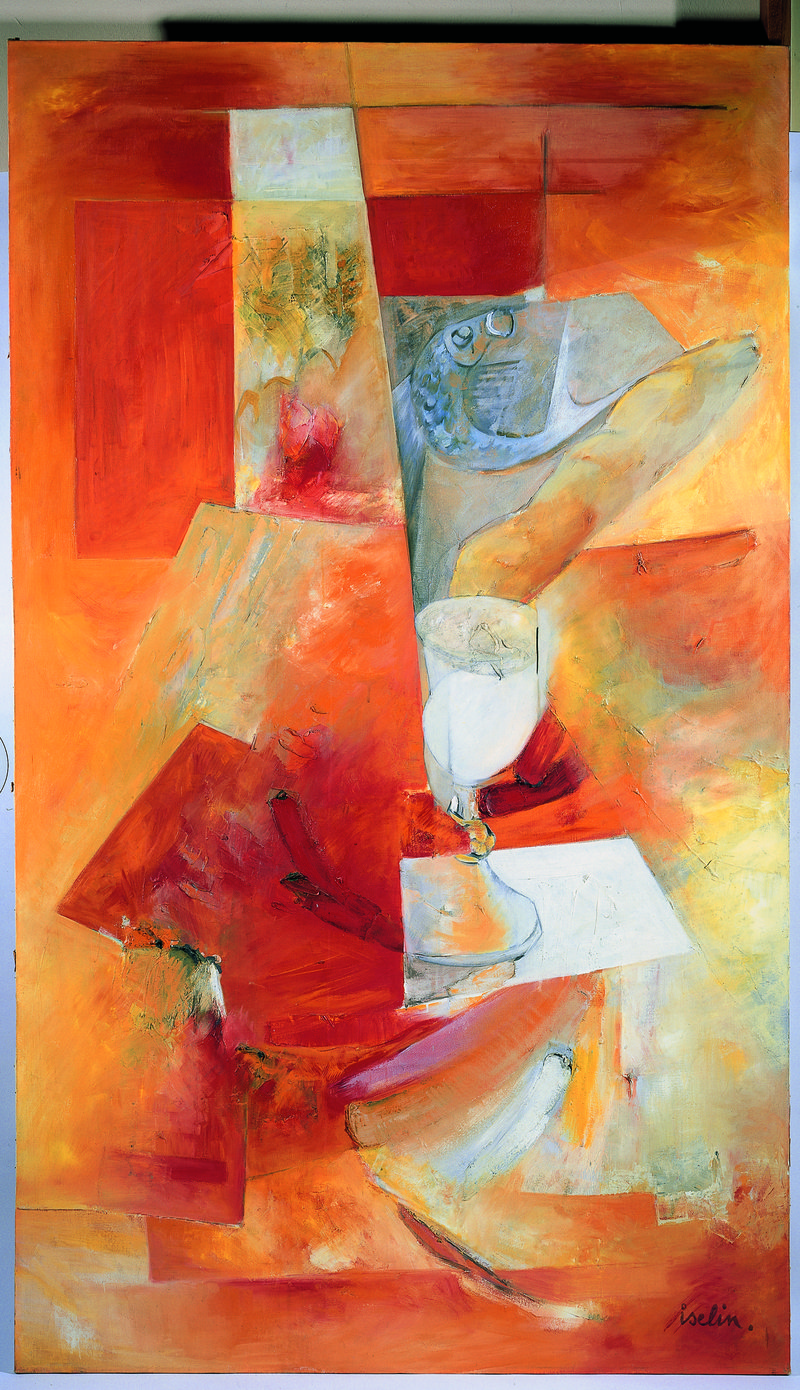
The elements of the Holy Communion: bread and wine. In this case, a baguette and a cup to hold the wine. Both present, but both also half hidden, only part of what is going on. What else is in the painting? What else is part of communion?
Perhaps most obviously, the fish jumps out at us, its silvery grey colour contrasting with the yellows, oranges and reds elsewhere. The Greek for fish, ICHTHUS, became an acronym among early Christians meaning “Jesus Christ, God’s Son, Saviour”, and thus a stylised fish came to represent Jesus and Christian allegiance. So here we have a representation of another (surely the very central!) element of communion: Jesus himself, still with us each time we celebrate communion.
But the way the fish is placed right next to the bread, I can’t help but be reminded of the fish and bread from the feeding of the five thousand. The fish and bread which started out as meagre and utterly inadequate, but became plentiful and abundant. During communion so often we are given just a tiny morsel of bread and only a small sip of wine or grape juice. And yet, what we celebrate is abundance – the abundance of the love of God, poured out for all. In communion a small meagre offering of bread and wine is transformed into the plentiful love of God, so strong that it could not be stopped even by violence or death, so ever-present that we can never be separated from it.
What of the coloured shapes cutting through the midst of the painting? Like shards of stained glass letting through light of different colours and reflecting it in different directions, they remind us of the many different ways in which people have seen, experienced and reflected on communion; be it an intense personal experience of love and mercy, an expression of community and fellowship that reaches across time and space, or a statement of radical inclusion in the face of societal or political exclusion. As many experiences as there are people and times they have received communion. Each person participating with their own perspective, their own context, their own relationship with God: yet another element of communion?
It isn’t just what has been painted that tells us about the elements of communion, though. It is also how it has been painted. Thick blobs of paint, give the painting texture and body. When much of what happens in our Sunday services is cerebral, focussing on words and thoughts, confined to the insides of our heads, communion is one of the few things that gives our celebration of God’s love body and substance. It is one of the few times we can engage our senses of touch and taste as we seek to encounter God, adding to the spiritual experience of being filled with the Spirit of God, a bodily experience.
Elsewhere are hints of many other things: ears of corn? Candles? A figure or angel? The elements of the Holy Communion? Bread and wine are just the start, it seems.
Biblical References
The institution of the Lord’s Supper (Matthew 26:26-29, Mark 14:22-25, Luke 22:14-20, 1 Corinthians 11:23-26)
The feeding of the five thousand (Matthew 14:13-21, Mark 6:30-44, Luke 9:10-17, John 6:1-14)


Leave a Reply