John Muafangejo
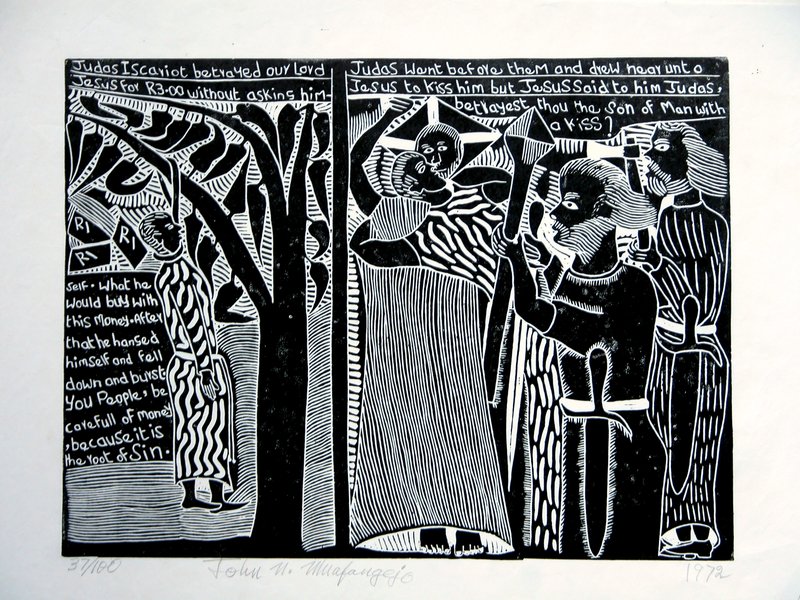
Judas: called to be one of the twelve disciples, and yet he betrayed Jesus in exchange for money, leading the authorities to Jesus when he was away from the crowds. “Betrayest thou the Son of Man with a kiss?’’ the artist picks out as a key verse alongside his depiction of Judas’ embrace. The method heightens the betrayal even further and makes us wonder: what can have gone on inside Judas to have betrayed Jesus in this way? How can he have spent all this time so close to Jesus, seeing and hearing all that Jesus did at first hand, and yet somehow apparently just not get it? How strong must his yearning for money have been? Or was he hoping this would be the start of Jesus overthrowing the powers that be? Did he even wrestle with his decision? Did he simply compartmentalise things? Or did he just never understand what the consequences of his actions could be?
Before we feel too superior and different, let’s take a look at ourselves. What are our own passions, obsessions or addictions that could lead us to betray our faith, our values, our very selves? Do we know what lurks within us? What experiences and situations might push us into a similar situation? Beyond where we think we would ever go? How vigilant do we need to be about ourselves?
Much of the artwork is stylised and bold. But Jesus’s face has a distinct softness about it; it carries an unmistakably compassionate expression. Jesus knew that Judas would betray him, and yet he didn’t throw Judas out of his group of close disciples, he didn’t exclude him from the last supper, and now even in this very moment of betrayal he still offers Judas love and compassion. But even if Judas notices it, it’s too late. And once Jesus has been condemned to death, Judas commits suicide before he can see that Jesus’ love and Spirit outlive death, that his dreadful deed was not as final as it seemed, that where he thought everything was over, God still saw a future.
So when we come to God in prayer, opening ourselves to God in honesty and looking deep within ourselves; whatever we see, whether it be hurt and pain, shame and guilt, loneliness and isolation, let us remember that compassionate look on the face of Jesus, that will never reject us or push us away, but will always welcome us with open arms and offer us a new start, will start to heal and transform us and not leave us to our own devices.
In the Bible Judas betrays Jesus for thirty pieces of silver; here it is for three rand, the notes fluttering in the wind like leaves falling from the tree: here today and gone tomorrow. So fleeting and transient. As easily lost as gained. What seemed substantial and something to hold onto proves to be worthless. By contrast the seemingly insubstantial Spirit of God, beyond detection by our normal senses, is eternal and ever present, a firm foundation to give our life meaning, strength and peace in all situations. To fill our hearts with love and bring newness of life.
Biblical References
Judas called to be a disciple (Matthew 10:1-4, Mark 3:16-19, Luke 6:13-16)
Judas betrays Jesus for money (Mark 14:10-11, Luke 22:2-6)
Judas betraying Jesus with a kiss (Matthew 26:47-50, Mark 14:43-46, Luke 22:47-48)
Jesus foretelling Judas’ betrayal (Matthew 26:20-25, John 13:21-30)
Judas commits suicide (Matthew 27:3-10)
Judas betrays Jesus for 30 pieces of silver (Matthew 26:14-16)
Leave a Reply