Pat Steir
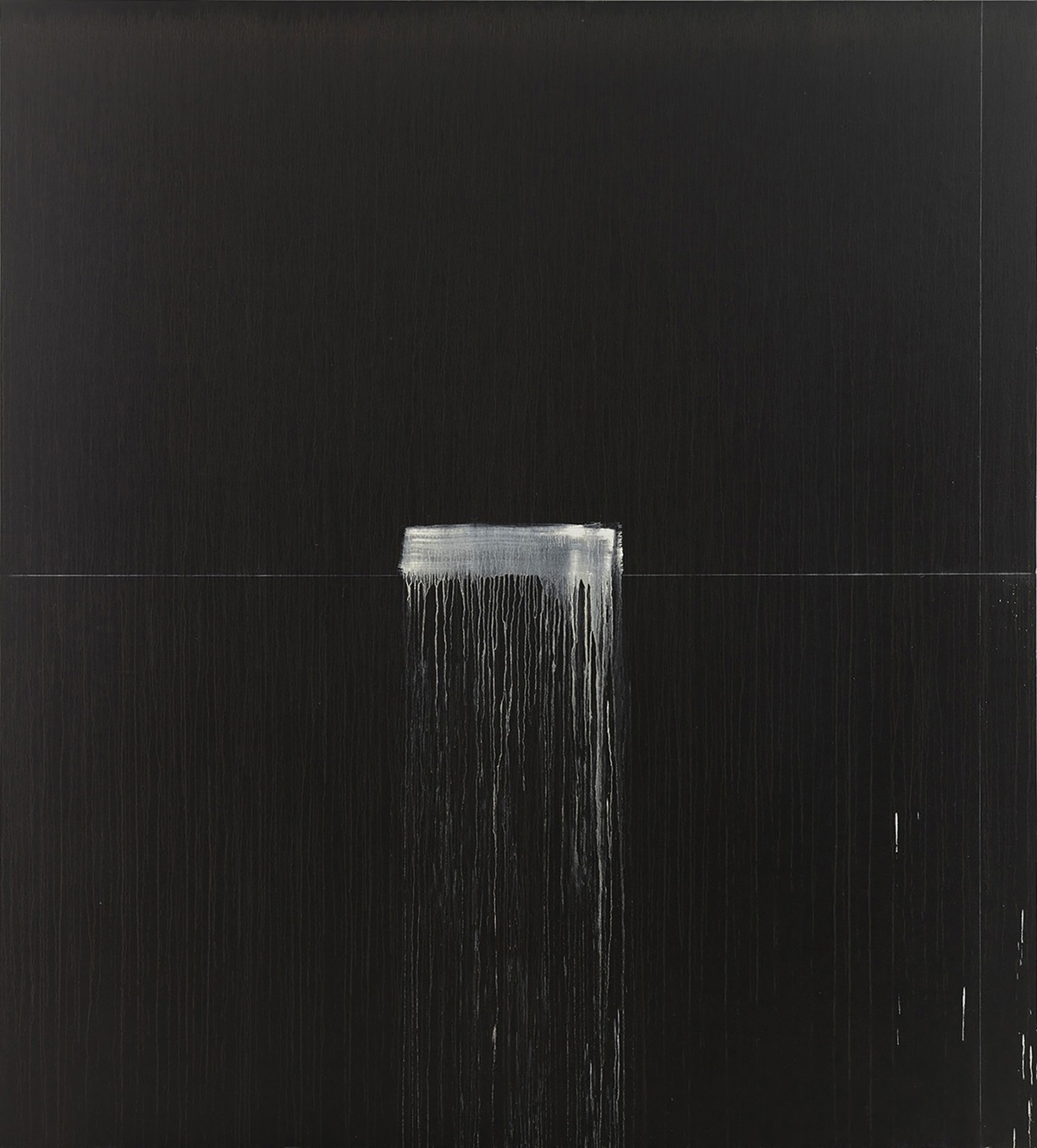
There are different types of black. There is the black which is simply the absence of anything: the black of outer space, the black of nothingness. Light would be of no use, for there would be nothing to reveal. Then there is also the black which is something, which contains something, which hides something. That is the black here in this painting. It has texture and substance. It is the darkness of night. Or the darkness which our lives are sometimes engulfed in? It is the kind of darkness which seems to call out for light.
In amongst her dark night, the artist offers us three different types of light. First there are two very thin straight white lines – one vertical and one horizontal. They seem to be trying to bring order. Sometimes order is beautiful, but not here. These lines feel rigid, and like a distraction from the interplay between the black and the white elsewhere in the painting. It manages to cut the darkness up into smaller chunks, but does it manage to take it away? Not really. Are they like our human attempts to order, contain and systematically describe the incomprehensible mystery of God? Not useless, but not quite the real thing, either? Not something that truly reveals God and helps us when we are in the dark.
Then there are the seemingly random little specks of white in the bottom right hand corner. They are thick and intense. They have the same depth as the darkness. They are of equal strength: capable of breaking it up and disrupting it. Is that what God’s light is like? Bright and intense? Appearing in random unpredictable places? If only the whole painting were covered in these – that would send the darkness packing! Or is that just our wishful thinking? Our hope that the divine will reveal itself in a flash of lighting? In reality, the number of our bright and intense experiences of God tend to be few and far between, just like these little specks of white. Not sufficient to deal with the vast scale of the night.
And finally, of course, there is that white brush stroke right in the middle of the painting. It feels feint and insubstantial compared to the thick specks; somewhat ineffective at holding the blackness at bay which is still visible in the background behind both the brush stroke and the dribbles of paint running down from it. But it is more effective at dealing with the black than anything else here. Is this the vulnerable God we see in Jesus who dies on a cross? Stupidity to the rational materialist, incomprehensible to those hungry for power. And yet enough light by which we can live in the darkness? In a strange way, this white brush stroke almost enhances the black, makes it richer. I am reminded of the Psalmist who writes of God that “the darkness is as light to you”. Are we being encouraged not to be dependent on what we perceive as light? Can we manage simply to sit with the darkness? Knowing that God is as present there as in the light? Is this what the brush stroke and God enable us to do – simply to sit and live with, perhaps even, in some cases, appreciate, the darkness elsewhere?
Biblical References
The darkness is as light to you (Psalm 139:12)
The Artist
Pat Steir is an American painter and print maker, born in 1938 who came to prominence in the 1970s and 80s. Find out more about her art on her website.
Leave a Reply