Francis Hoyland
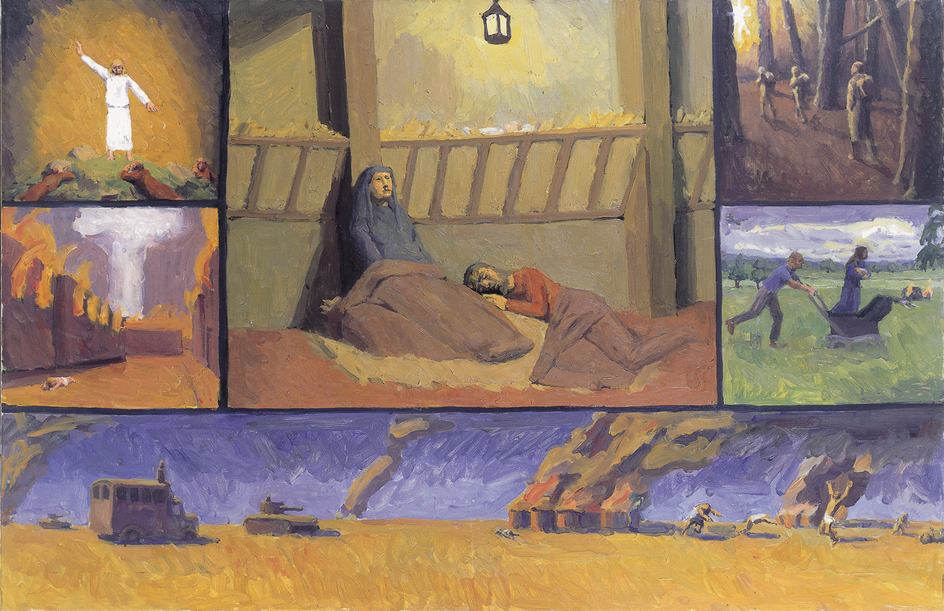
One of the most fascinating things about this polyptych is the central image of Mary in the stable alongside Joseph and the baby Jesus. This Mary is so different to the one we see in most traditional nativity scenes: she has not been made to look Instagram perfect, with beautifully styled hair and clothes, lovingly doting on her baby; but instead she looks utterly exhausted, glad that the baby is at long last asleep and as though she is now finally able to start working through what has actually happened to her, replaying that extraordinary experience of giving birth for the first time in her mind. Mary – not as the perfect saint, but a normal human being like the rest of us. For the first time a Mary I can relate to, because here she is as vulnerable and confused after giving birth as I was.
It is important for us to have others to be able to relate to, not to feel on our own. What is it that makes that possible? What helps us bring us close to others? When have our friendships and relationships deepened and grown? When all is well and rosy, or in times of struggle? When we’ve have ‘been through thick and thin’ together? When we have opened up to one another, supported one another, cried together and held one another? Putting a perfect gloss on our lives, as so many nativity images do on the life of Mary, isn’t likely to bring us any closer to others. Is it not in our vulnerabilities that we connect to one another most deeply?
And isn’t that what we see in Jesus, too? For Jesus wasn’t just vulnerable in the manger, as he is here in this painting. He maintained that vulnerability as an adult: he chose to be reliant on others; chose to depend on other people’s generosity and hospitality; chose not only to teach in synagogues, but to spend time with disreputable outcasts; chose to engage with people on their terms, in their space; chose to reject power, riches and social respectability; chose, in the end, to put his life in the hands of others, even when that meant being tortured and killed. By making himself vulnerable, Jesus formed deep, loving connections with other people and gave them the opportunity to let the love of God into their lives and to see new possibilities for themselves.
And today, for us? Does God come in power or in vulnerability? Does God come with power to sort out our messy life and turn it into the perfect ‘Instagram-able’ life? Or in vulnerability, with an offer to walk alongside us and reassure us that we are loved and of value and can be at peace, whatever happens? Relying on us to open our hearts to God to make this possible? Does God come in power to sort out the injustices of the world? Or vulnerably to grieve with us over the state of the world? Relying on us to be moved to help make things better?
Can we form the mutual relationships of love and service that spring out of shared vulnerability both with one another and with God?
Biblical References
Mary giving birth in a stable (Luke 2:1-7)
Leave a Reply